Hard Bidding is for the Birds – IPD Could Be the Way to Go
In the economic climate that we find ourselves at the moment, it seems that the only projects out there are public jobs where bids 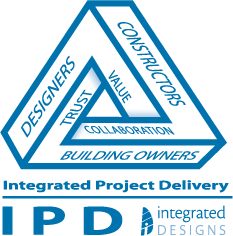 are solicited and any warm-blooded creature with a pulse and a remote ability to read plans can submit a price on the job. The municipalities are required by law to accept the lowest responsible bid. Of course words like responsible can be interpreted in many ways, so the public entity reserves the right to exclude bids from companies that they feel are not capable of performing the work. However, when tax dollars are in the mix, I would think that it is difficult to justify not taking the low bid especially if they can provide the bonding and insurance requirements.
I’ve been doing a lot of hard bidding lately with only very limited success. Last week I bid a $4 million animal sanctuary where there were at least ten other bidders. Of course I didn’t get the job, and not only was I frustrated at wasting nearly a week putting this bid together, I was also frustrated by wasting the time of 50 or so subcontractors that delivered bids to me. If we think about all the time wasted on this bidding process from all ten bidders and potentially hundreds of subs, the man hours begin to hit the stratosphere. Sometime I think that there has go to be a better way.
Well, there probably is, and it is call Integrated Project Delivery (IPD). IPD is a negotiated form of project delivery where risk and reward are shared among the owner, architect, prime contractor, and sometimes even subcontractors. IPD emphasizes early involvement of contractors and collaboration of team members throughout the project. Interestingly, trade contractors are considered the most crucial element of early project collaboration because their input will have significant impact on design and project cost.
Jonathan Cohen with Integrated Project Resources recently published six case studies of IPD projects through the American Institute of Architects. Cohen defines IPD by projects having the following characteristics:
• Early Involvement of Key Participants
• Shared Risk and Reward
• Multi-Party Contract
• Collaborative Decision Making and Control
• Liability Waivers Among Key Participants
• Jointly Developed and Validated Project Goals
Cohen goes into analysis about each individual project but sums up the study by writing:
In every case these projects met or exceeded the owner’s expectations with respect to budget, schedule, design quality, and sustainability and also met the financial expectations of designers and builders. Every participant interviewed was enthusiastic about IPD and eager to try it again.
I think IPD is certainly the method of project delivery that makes the most sense, but will certainly involve more upfront investment of time and money in a project. Will owners be able to stomach this release of monies early in the construction project in hopes of delivering a better product? Evidently they have and will hopefully continue to do so.
It will at least cut down on the hours of wasted bidding time.
Tags: Construction blog, Construction Economics, integrated project delivery, John Poole


I agree that hard bidding is a waste of time and resources. It puts estimators out of touch with what’s really going on with a project and the people involved. IPD weeds out those who want to work in their own bubble, and it gives the project itself top priority.
Hard bidding to 10 contractors is a huge waste of time for the contractors and their subs. And it results in poor bids because everyone knows 10 people are bidding and they become inclined to cut corners or low-ball estimates with the expectation that they will make it up in change orders later. The firm requesting the bids then gets intoxicated by the low prices and actually thinks they can magically hold contractors to the price.
Well, I’ve recently seen subcontractors walk off jobs because they realized they did not quote properly and the customer would not agree to a change order. So what did the bid really cost?
The entire system is flawed and is one reason why construction has actually declined in productivity by .6% per year for the past 40 years while other large industries have improved productivity. Imagine if an airplane manufacturer designed a part and then had 15 suppliers quote it – only to take the lowest bidder. Good luck building high quality planes on time. Today’s mature industries partner with key suppliers, include them on the design team, and end up with higher quality, lower cost product.
This is a link to the IPD case studies referred to:
http://aia.org/ipdcasestudies
This discussion has been going on for my entire career, which spans 30 plus years. As one who grew up in the hard bid world, I would say without hesitation that hard bidding will never die, there are just too many Owners, users and buyers that get enamored with that low number. And we all know, nothing says quality like a low bid!
Whether you call the “front end” work IPD, PreCon(CM) or Program Management the real defining moment in any project is on the front end when the decision is made by the Owner on how they intend to manage the project. If Owners don’t engage, it doesn’t matter what delivery system is involved, because somewhere along the way they will be unhappy that their expectations aren’t met!
Does anyone believe for a moment that owners aren’t squeezing design fees? When low bidders bid on the low bid design do we really think that everything that needs to be put into the documents makes it there?
Yes, hard bidding is here to stay and the successful hard bidders will continue to be the ones who identify the holes in the documents before they submit their bids. Can you say Change Order?
I’m glad to see this discussion and interest happening.
It seems to me that the underlying emotional reality of hard bidding is a lot of scarcity, fear and power plays, on the parts of all the players. As that changes for each of us, I look forward to what we will create in it’s place