Make Crane Safety Priority One!
This post was written by SPANCO, an industry leader in overhead cranes since 1979. You can find a variety of products on their website including jib cranes, gantry cranes, or an electric hoist.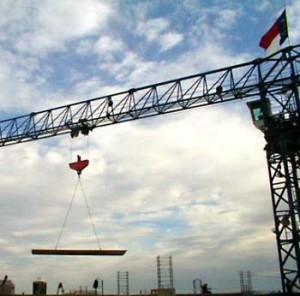
Moving heavy loads around a work environment demands careful attention to safety. Accidents can take a hefty toll in life, limb, and material damages. A fundamental knowledge of inspection, maintenance, and operating procedures can make the difference been smooth operation and a tragic mishap.
THE EQUIPMENT
Reducing the likelihood of hazards during crane rental operation depends on several factors. We’ll cover a few of the basics here. Overhead and gantry cranes have three axes of directional travel: vertically in the direction of the hoist and load hook, laterally along the path of the trolley, and forward and back along the path of the bridge. Operators and drilling contractors should be trained in the crane’s capabilities, movements, speed, control settings, and safety devices.
While cranes are made of high-strength steel, one should never exceed the crane’s rated load capacity. Attempting to move a load greater than the crane’s capacity can put undue stress on the equipment and can endanger workers. Second, controls must be inspected regularly to be sure that all motions agree with the controls as marked. When working with overhead and gantry cranes, be alert for excessive drift or irregular stopping distances. Check hooks and wire ropes for damage or fatigue (excessive wear, nicks, gouges, fraying, broken strands, kinks, or deformations), and be sure all wire ropes are properly reeved. Be sure that any damage noted on daily inspections is properly documented, marked, and reported to supervisory personnel. Wire ropes should never be wrapped around a load or used as slings unless specifically designed for this use.
Also, check that upper-limit devices stop the load properly. Staying alert for other trouble signs—such as oil leaks or unusual sounds—not only promotes safety but may help avoid costly repairs. Be sure that all provided warning devices—bells, gongs, sirens, strobes, etc.—are in working order. Also check that the crane or hoist has not been tagged with a lock-out tag or cut-off order sign.
Finally, a clean and well-lighted work area can prevent mishaps. All cranes require regular maintenance to ensure safe operation. See the manufacturer’s guidelines for information and requirements.
THE LOAD
Moving large loads safely depends a great deal on the load itself. For example, loads should be stable and balanced. Testing a load by lifting it a few inches can help to determine whether the load is stable enough to be moved to its destination. Loads should be moved smoothly and at safe speeds to avoid jerking and shifting. Loads should never be moved over areas where other employees are working. Do not use cranes to attempt a sideways pull of a load. When not in use, loads should be lowered and secured. If a crane is to be left unattended, the operator must land any attached load, place the controllers in the “off” position, and open the main switch. Before closing a main switch, all controllers must be set in the “off” position.
THE HUMAN ELEMENT
The best asset in crane safety is having trained and qualified personnel. Well-trained operator and workers can mean the difference between safe operation and a needless hazard. Operators and workers who understand the safety features of their equipment are far less likely to experience costly or life-threatening accidents. An emergency response plan in the event of an accident can help prevent or reduce injury and damage. Attorney Stephen Phillips provides legal advice on such cases. To ensure safe and accurate operation, workers and operators should know and practice proper hand signals. (See page 10 of the CMAA Crane Operator’s Manual for detailed illustrations of proper hand signals.) The crane operator should respond only to signals from the worker directing the lift. In the event of power failure, the operator must place all controllers in the “off” position. Workers should remain on the work floor and should never “ride the load.” Manual warning devices (when provided) or verbal cues should be used to warn workers when a load is beginning to move or when workers are in the path of the load. No repair, inspection, maintenance or other work should be done under a suspended load.


I agree how important it is for there to be an emphasis on safety using heavy machinery like cranes. This guide is useful for operators of MEWPs and access platforms: http://www.universalplatforms.co.uk/docs/Universal_MEWPs_Guide_1s.pdf